November 10, 2024. Ben Murphy
The hospital chimney stands today as it has since August of 1942. The lonely, iconic structure at the top of the hill is a reminder of the human drama that took place at this confinement site. Standing sphinxlike, the chimney has kept a secret for over seventy years, a mystery hidden in plain sight.
The hospital complex, completed in 1942, relied on the boiler house to provide steam heat during cold Wyoming weather. An essential feature of the boiler house, the smokestack stood as the most prominent structure at the center, as it does now. Of the ten Japanese American “Relocation Centers” constructed in the U.S. during World War II, Heart Mountain retains the most intact hospital complex, of which the smokestack is the most distinguishing feature. This status was maintained when restoration and stablization work was completed in 2013.
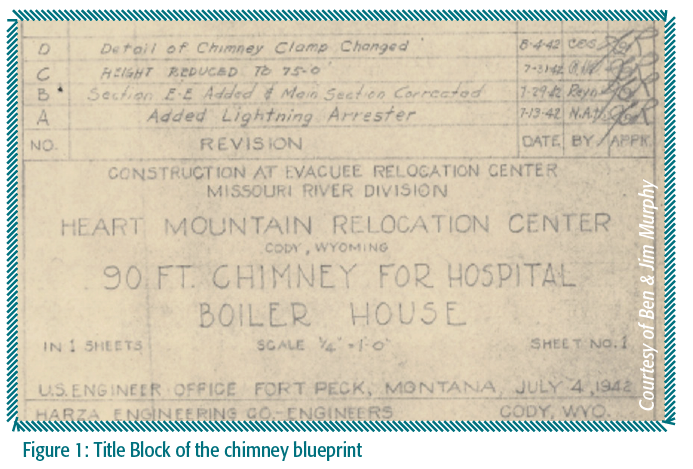
In researching the camp’s infrastructure, the authors examined the U.S. Army Corps of Engineers blueprint from which the chimney was constructed. They were puzzled by what they found. While the title block for the drawing (Figure 1) states clearly “90 Ft. Chimney for Hospital Boiler House,” the plan itself just as clearly shows a structure that is seventy-five feet high. Things seemed to be clearer upon reading the note for Revision C: “Height Reduced to 75’-0”” However, the date of the drawing is July 4, 1942, while the date for Revision C is July 31, 1942; in other words, the chimney’s height was reduced by 15 feet about three weeks later. The speed of construction was so great to get the Camp built that in that three-week span, much of the chimney may have already been constructed. In essence, the height of the chimney may have been reduced from 90’ to 75’ at the last possible minute. Why did the finished product not reach the heights that were originally intended?

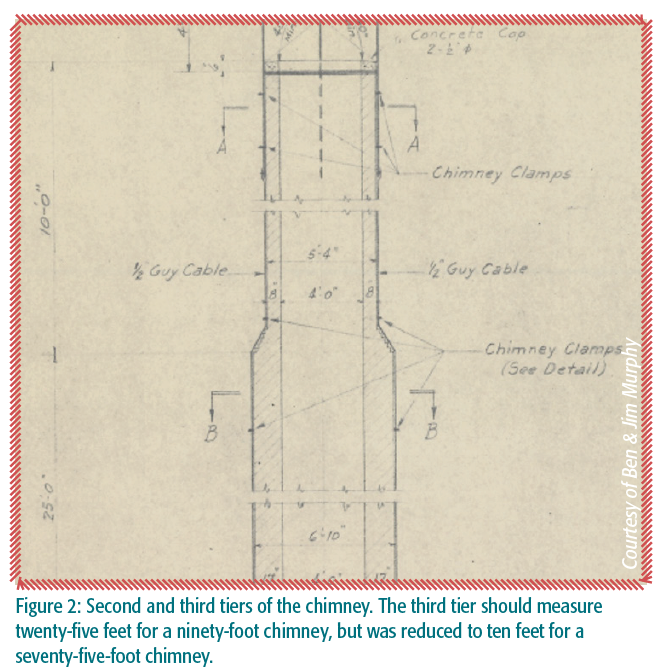
Figure 2 shows a portion of the chimney’s original engineering blueprint. While the interior opening of the chimney is consistent throughout its height, the exterior has three distinct cross-sections, highlighted by two step-back shelves. The drawing shows the top two tiers of the chimney, measuring twenty-five feet and ten feet in height respectively, making the overall chimney height at seventy-five feet. The lower portion measures forty feet. Revision C reduced the topmost portion of the chimney by fifteen feet, from twenty-five feet to ten feet.
In the post-war years, the authors lived on the land of the former confinement site. During these three years, they saw the chimney just about every day, accepting its height as what was intended by the original designers. Looking at what could have been, it is apparent that a structure fifteen feet higher would have made the chimney a more imposing, and aesthetically pleasing, structure.
Figure 3 shows a rendering of the chimney ‘as built’ and ‘as designed’. The ‘as designed’ structure results in an attractive, 90-foot, proportioned structure, while the 75-foot chimney that was built looks “chopped off” by comparison.
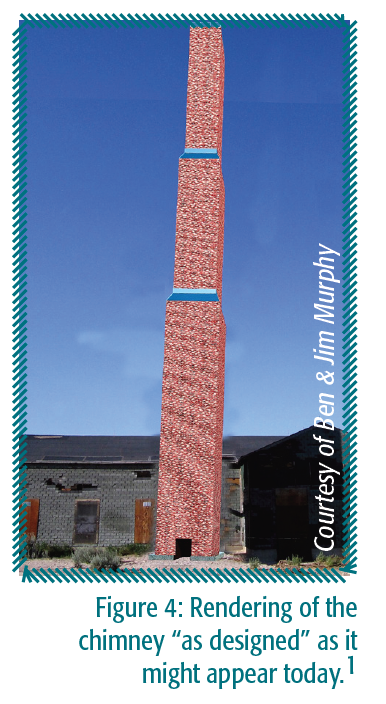
Figure 4 shows another rendering of how the boiler house and a 90-foot chimney might look today.
No documentary evidence has been found by the authors to explain the last minute change in design. One possible theory is that with the extreme pressure to complete Heart Mountain in 60 days, a labor, materials, or time shortage could have shortened the height.
However, it is more likely that it may have been the architect’s concern that a 90-foot unreinforced masonry structure would not stand up to Wyoming’s frequent blizzards. Indeed, should the chimney have been built to its original design height of 90 feet, the top portion, or the whole structure, may have succumbed to the region’s harsh winters long ago.
Viewed critically, the chimney looks incomplete, suggesting something is amiss about its design or construction. Knowing the original design intentions adds to the story of this structure and indeed to the story of Heart Mountain. Who knew that this “ugly duckling” was designed to be a “graceful swan?”
 Bernard Murphy and James Murphy