Chapter notes
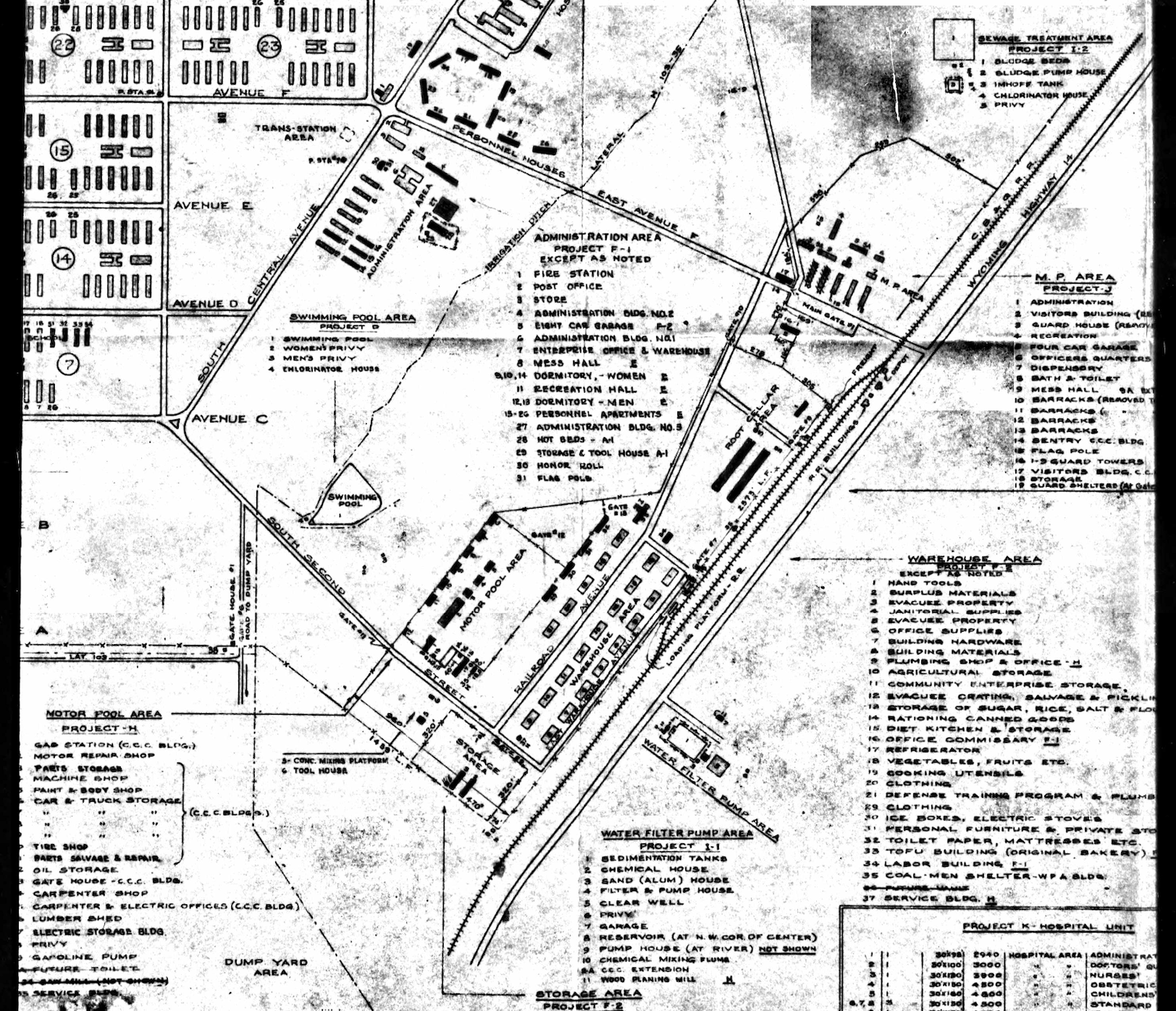
National Archives and Records Administraion, “Plan of Center Area,” Heart Mountain Relocation Project-Blueprint, image 239,Ancestry.com database online

Water volume in the service reservoir, supplying water to the Camp. National Archives, War Department, Office of the Area Engineer. Completion Report: Heart Mountain Relocation Center, September 22, 194, Appendix E-1.
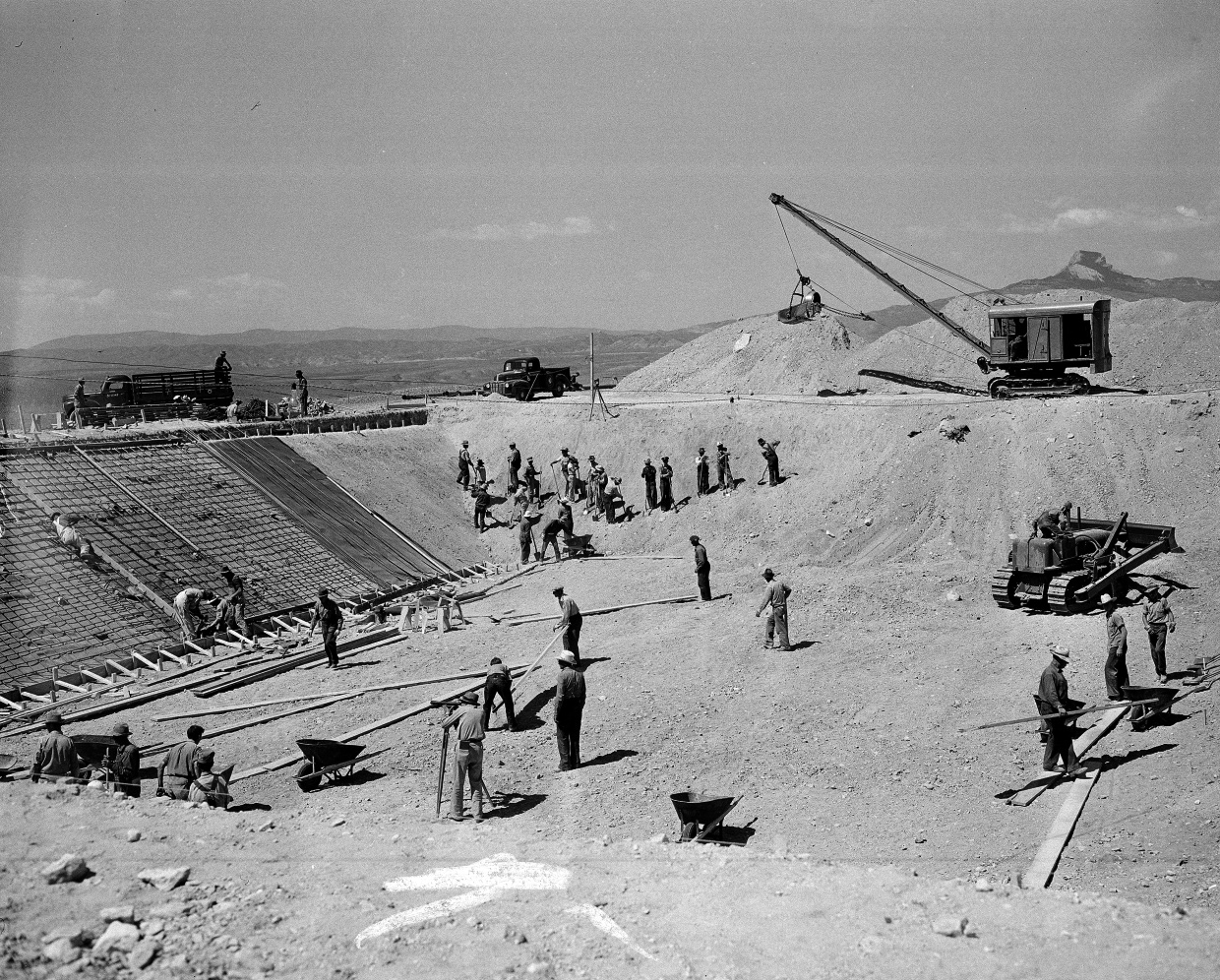
Photo: AP /Edward O. Eisenhand, 1942. “Workers build a reservoir in Cody, Wyo., where 10,000 Japanese American evacuees from the Pacific Coast will be relocated to the Heart Mountain relocation center. The evacuees will be kept busy converting this barren land into a pea, bean and potato farm.”
PROVIDING ELECTRICITY, WATER, & SEWER SYSTEMS
A compelling requirement of the Heart Mountain Relocation Center’s design was that it must be completed in 60 calendar days or less. An entire facility capable of housing 11,000 persons, including all utilities, had to be ready for occupancy before the arrival of 23 trains, each containing about 500 Japanese ‘prisoners’, from assembly centers—themselves recently constructed along the West Coast, most located in California. Army timetables indicated that the first such train was to arrive at the Heart Mountain Relocation Center on August 12, 1942, which was the date the Camp was to open to receive them. The Camp must, somehow, be ready to receive them on August 12.
The site selected for the Heart Mountain Center was arid, treeless land that barely supported native buffalo grass, sagebrush, rabbits, and snakes. It was undeveloped, save for a network of irrigation ditches built previously by the Bureau of Reclamation to enable irrigated agriculture.
Designing and building, within an impossibly short time, from scratch, utility networks for domestic water, electrical power, and a sewage system was a daunting, almost overwhelming task. Water was available in the Shoshone River, which ran within a mile east of the site, and electrical power, which, almost miraculously, could be obtained by an electrical transmission line exactly crossing the site of the proposed camp. A sewage system, together with a treatment plant, was required to meet Wyoming’s sanitation standards.
The domestic water system that was ultimately built included a one-million-gallon concrete-lined water reservoir built on high ground above and west of the Camp, two pumping plants, two settling basins, a chlorination pond, and about 5 miles of water mains ranging in diameter from 8 inches to 12 inches. In addition, water service to 108 structures plus the hog and chicken farms was constructed.
Electrical power obtained from a 33 KV (33,000 volts) electrical transmission line crossing the site was tapped and the transmission voltage was reduced to 4,160 volts for distribution to the 632 structures comprising the Camp’s infrastructure.
A total of 55 transformers of various sizes were employed throughout the Camp to step down the Camp’s 4,160-volt primary voltage to the standard 120-volt household voltage.
These facilities, literally thrown together to meet the August 12 deadline served the Camp satisfactorily throughout its life, and they continued to serve after the residents of the Camp left when the war ended. The Bureau of Reclamation managed the Camp and its utilities running well into the 1950s as the Camp ceased to be an incarceration camp and became a construction camp as the Bureau of Reclamation completed the construction of the Heart Mountain Division of the vast Shoshone reclamation project.

